
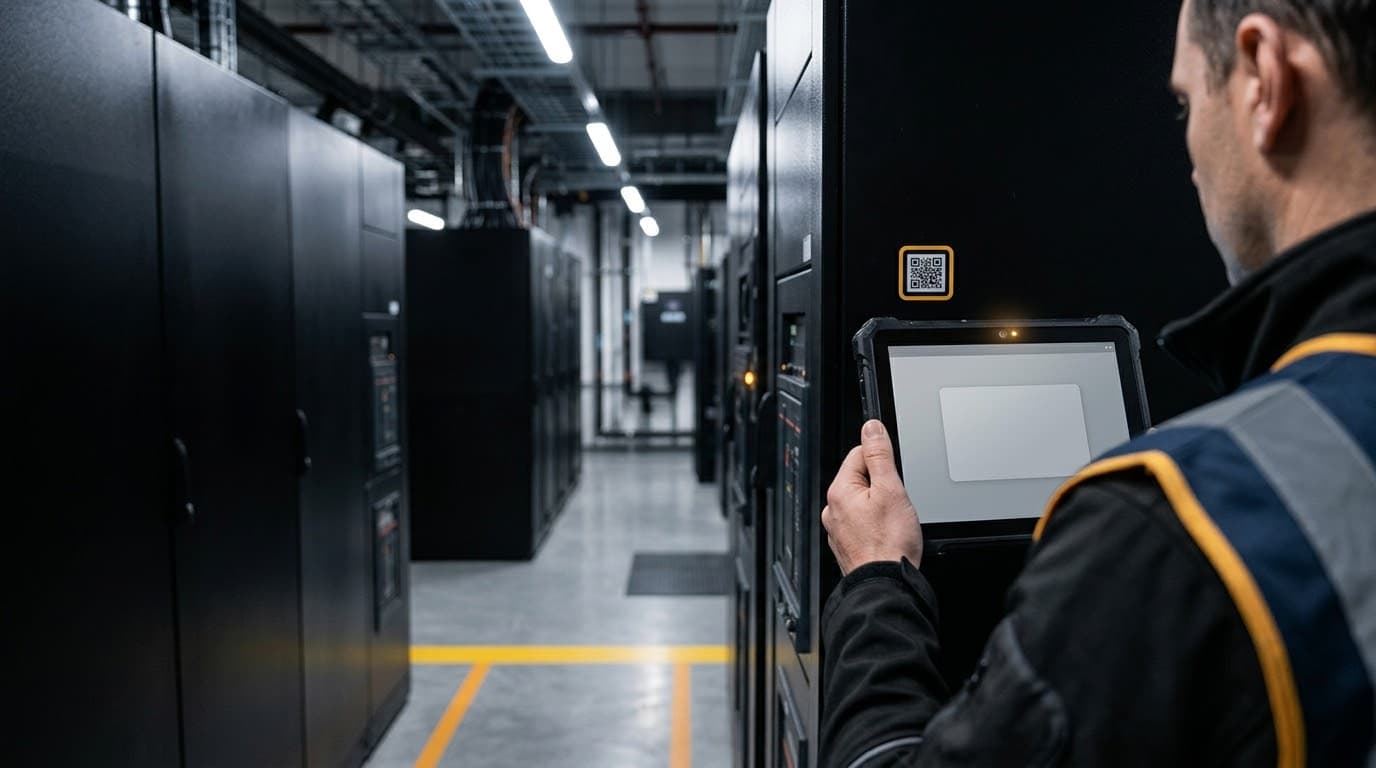
A single generator, from the order to its next life.
Twelve stages, one QR code. At each: who acts, what the AI assistants do on their own, and the proof the record needs before it can move. Arriving has hold points, and so does leaving — nothing can be skipped at either end, and the whole trail is tamper-evident.
Every stage, three questions: who acts, what the assistants do, and what it takes to move on.
Before the orderStage 00
Design-phase QA sets the requirements this machine must meet — feasible, testable, compliant — with any shortfall logged as an approved deviation.
- Who
- Engineers and QA sign off, on the record
- The AI assistants
- Nothing yet — this stage is people deciding. The assistants pick up at the order.
- What it takes to move on
- Requirements are reviewed before the order is placed; nothing is built against an unreviewed spec.
Ordered and inboundStage 01
Custody starts at the purchase order — tracked before the machine is even built. The QR code is minted here; the sticker prints and waits at the dock.
- Who
- The project manager places and links the order; the vendor confirms and ships
- The AI assistants
- Document Control chases the factory documents; Asset Lifecycle flags the day an ETA slips
- What it takes to move on
- The list of what this machine owes is set; arrival can be reconciled against the order.
DeliveredStage 02
Arrival is checked at the truck, step by step: nameplate and serial photos, damage inspection, count reconciled against the order. Shortages become attributed deficiencies.
- Who
- A technician at the loading dock
- The AI assistants
- Document Control emails the vendor for missing test reports and follows up
- What it takes to move on
- Every receiving step in order, each with its proof — a machine cannot silently appear on site.
StoredStage 03
Where it sits and how it is protected — the stage everyone skips. The machine arrives on a storage regime suited to what it is: covers and wrapping weekly, space heaters and desiccant on switchgear and transformers, shafts turned on anything with a bearing, nitrogen pressure read on anything shipped under a charge. Each check comes due on its own interval and is recorded as it happens.
- Who
- A technician on periodic walk-downs
- The AI assistants
- Nothing here waits on an assistant: the regime starts itself the day the machine is received, ends itself the day it is installed, and every check sets its own next date
- What it takes to move on
- A check names who made it, when, and the proof its requirement asks for — the reading, the photograph — and is refused without it. A miss shows as overdue on the machine and on the register; it never vanishes. A failed check opens a deficiency with a clock on it, like any other defect. This is what wins the warranty dispute years later.
InstalledStage 04
Anchor bolts torqued to spec, clearances measured — the step nothing skips. Each step carries its proof, and the machine's exact position in the room is locked in.
- Who
- The sub sets it; the technician observes; the supervisor signs off
- The AI assistants
- Asset Lifecycle advances the phase and updates every register the moment the check closes
- What it takes to move on
- Step 4 wants a torque reading in range plus a photo. Until it has one, step 5 will not open and the check cannot close. No override.
TestedStage 05
Who performed the test matters as much as the result — insulation resistance, load bank, each record attributed to the qualified party.
- Who
- A qualified sub performs; the QA technician documents
- The AI assistants
- Document Control files each test record and flags any required test still missing
- What it takes to move on
- Every test record carries who performed it and their qualification. The QA firm observes and documents; it never performs.
A deficiency, found and fixedStage 06
Something is wrong — a coolant line rubbing a bracket. One tap logs it with a photo, a severity and a clock; pin it on the drawing.
- Who
- The technician logs it; the sub fixes it; the supervisor verifies
- The AI assistants
- Quality Inspection classifies the severity and drafts the notice to the sub; if it sits too long the escalation waits for a person to send
- What it takes to move on
- Closing takes the fix evidence and a named verifier. "We took care of it" is not a state the record has.
CommissionedStage 07
The L1–L5 sequence: pre-functional, functional performance, then the integrated systems test — each level earning its colour tag before the next opens.
- Who
- The commissioning parties perform; technicians observe; supervisors witness the hold points
- The AI assistants
- Commissioning tracks the sequence and schedules the retest when a test fails
- What it takes to move on
- Each level opens only when the one before it is complete; a failed item blocks until retested; a hold point stops work until it is signed.
TurnoverStage 08
The package was finished before anyone asked. Every document, test, photo and signature is already indexed.
- Who
- The manager reviews; the client formally accepts, inside the record
- The AI assistants
- Closeout kept the package current all along; the final submission waits in the approvals queue for a person
- What it takes to move on
- The package knows what it owes — it cannot claim complete while any required item is missing, and it names which.
Operating and maintainedStage 09
Most software goes dark here. Not this record: the warranty counts down, preventive maintenance rolls on its schedule, and every service visit lands on the same timeline.
- Who
- Facility staff scan the same QR; vendors respond to the schedule
- The AI assistants
- Asset Lifecycle raises the warranty warning at 90, 60 and 30 days and keeps the maintenance routines scheduled
- What it takes to move on
- Maintenance items are dated, attributed, evidence-backed tasks — the chain of custody does not loosen after handover.
Packed up and removedStage 10
Leaving takes the same proof as arriving: safe disconnection verified, fluids drained, condition photos, an exit scan at the dock.
- Who
- A qualified trade disconnects; the technician runs the removal check; the supervisor signs the release
- The AI assistants
- Asset Lifecycle opens the removal check and updates the register the moment the machine exits
- What it takes to move on
- Same rule as installation — no disconnection sign-off, condition evidence and handoff signature, no exit. Nothing walks out off the record.
Retired — or passed onStage 11
Two endings, both keeping the record whole: scrapped, with a final archived entry, or sold — the new owner scans the same QR and inherits the machine's entire documented life.
- Who
- The current owner approves the transfer; the new owner accepts
- The AI assistants
- Asset Lifecycle packages the history and re-points the QR; the transfer itself waits for a person to approve it
- What it takes to move on
- The history is never edited in a handoff. Each owner's era stays sealed and theirs — and any change to the record is detectable.
Not just complete. Verifiable.
Every entry is sealed against the one before it. Alter or remove one and it shows — inside the platform or from your export. A claim in year six is answered by month two, with the name and the date on the line.
Put one of your jobs in it.
Thirty days, no card, your whole crew. The trial workspace opens with one machine already at its first hold point.